
Innovation Beyond Surfaces
Developing next-generation microcement solutions for durable, seamless and sustainable architecture
Why Choose Keyenli Microcement Wall System
Engineered for modern architecture, Keyenli Microcement combines seamless aesthetics, durability and versatile performance for residential, hospitality and commercial spaces.
Seamless Surface
No grout lines, continuous architectural finish.
Thin Application
Renovate existing surfaces without demolition.
Custom Colors
Multiple natural concrete tones.
High Durability
Designed for residential and commercial use.
What Is a Microcement Wall System?
Different areas have different needs. We provide the right flooring systems to meet the functional and performance requirements of each space.
Wall Microcement is a highly cost-effective microcement solution specially developed for wall applications. It is a water-based material made primarily from acrylic resin and marble sand, delivering a microcement-like texture and decorative finish.
It is mainly applied with a stainless-steel trowel and can also be combined with different tools and application techniques to create a variety of textures and visual effects.
As a ready-to-use hybrid material, it requires no mixing or formulation—simply open and apply.
Wall Microcement combines the refined texture and durability of traditional microcement with a more accessible price, making it an ideal solution for a wide range of projects. It can be combined with floor microcement to create a seamless, uniform-color finish across walls, ceilings, and floors.

Microcement Wall Application Process
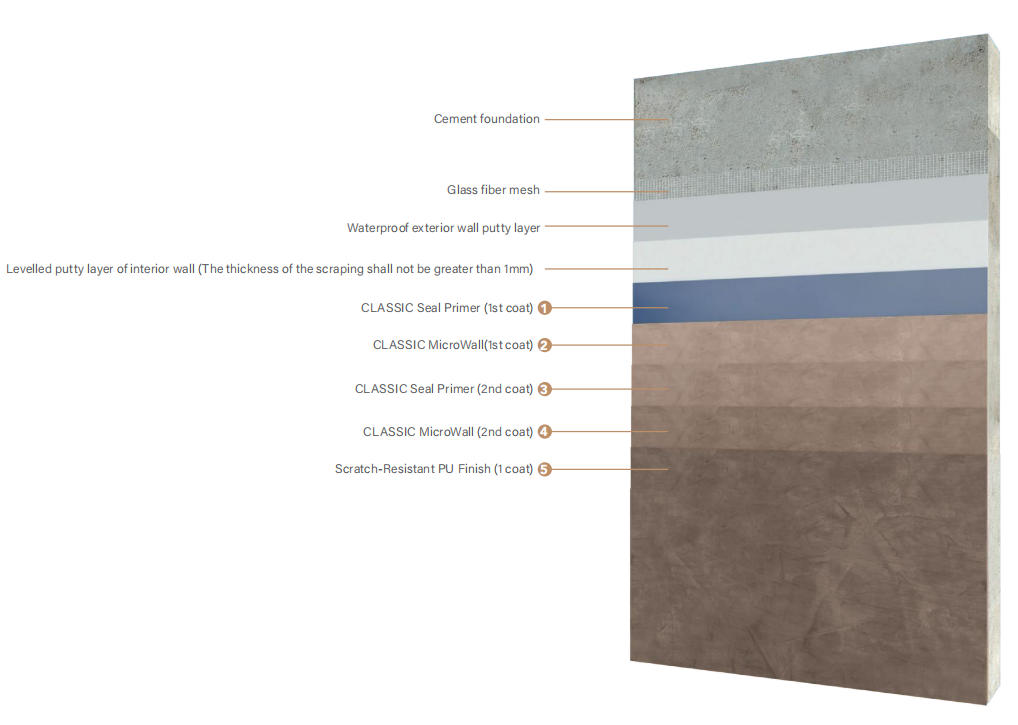
Step 1 | Sealer Primer
After the substrate has been properly prepared and is clean, dry, and smooth, apply one coat of sealer primer evenly using a roller. Allow it to dry completely.
Step 2 | First Coat of Wall Microcement
Mix the Wall Microcement to the desired color and apply the first coat evenly using a stainless-steel trowel. Control the application thickness and texture according to the desired decorative effect. Allow it to dry completely before sanding.
Step 3 | Second Coat of Wall Microcement
Apply the second coat of colored Wall Microcement to further improve the surface smoothness and texture. After drying, sand the surface carefully to achieve the desired decorative finish.
Step 4 | Sealer
Apply one coat of sealer evenly using a roller to enhance surface sealing performance and provide a suitable base for the protective topcoat.
Step 5 | PU Topcoat
After the sealer has completely dried, apply one coat of PU topcoat evenly using a roller. The PU topcoat provides the final protective layer and improves the wall’s stain resistance, water resistance, and scrub resistance.
Microcement Wall Case Studies
Discover seamless wall finishes that bring texture, character, and elegance to modern spaces

Residential

Experience Stores

Fashion Stores

Offices

Boutique B&Bs

Hotels

Villas

Bookstores
Microcement Wall FAQ
How long does microcement typically last? How can I change the color?
Microcement can typically last more than 10 years when properly installed and maintained, provided that the underlying substrate remains stable and in good condition.
If you want to change the color, the existing surface can be recoated with a new color without removing the entire microcement finish.
We recommend choosing timeless, classic colors from the beginning to create a finish that remains stylish and visually appealing for years to come.
How resistant is microcement to dirt and stains? How should it be maintained?
Microcement is highly resistant to dirt and stains and does not get dirty as easily as conventional wall paint, making it very easy to maintain.
For localized stains, simply wipe the surface with mild soapy water. For more stubborn or larger stains on floors, a professional cleaning product can be used when necessary.
Is microcement really as good as people say? Why do some microcement projects fail?
Microcement offers an excellent solution for creating seamless, continuous, and modern surfaces. However, like any decorative material, it is not completely flawless and its final performance depends heavily on the quality of the system and installation.
Many problems seen in failed microcement projects are related to improper surface preparation, incorrect application techniques, unsuitable materials, or insufficiently trained installers. In some cases, low-quality or unsuitable products may also be used.
When the right materials are combined with proper substrate preparation, professional installation, and the correct protective topcoat, microcement can deliver a beautiful, durable, and long-lasting finish.
Can microcement be used on exterior walls?
Yes, microcement can be used for exterior wall applications when a suitable exterior-grade microcement system is selected. The overall system is typically applied at a total thickness of approximately 3 mm, providing a durable and seamless decorative finish.
Using microcement both indoors and outdoors can create a more consistent and cohesive architectural aesthetic, making it an attractive choice for modern residential, hospitality, and commercial projects.
For exterior applications, proper substrate preparation and a suitable protective topcoat are essential to ensure long-term performance under outdoor conditions.
How Can You Evaluate the Quality of Microcement?
A practical way to evaluate microcement quality is to test a sample for stain resistance, abrasion resistance, color consistency, and flexibility.
① Stain Resistance Test
Use an oil-based marker to write on the sample surface. Then wipe it with an organic solvent, such as alcohol. Check whether any stains remain and whether the contaminants have penetrated into the surface.
② Abrasion Resistance Test
Apply approximately 1 kg of pressure over an area of 1 cm² and rub the surface back and forth ten times. Observe the sample for visible scratches, wear, or surface damage.
③ Color Consistency Test
Compare samples from different production batches to check whether there are noticeable differences in color and appearance.
④ Flexibility Test
Apply a layer of microcement onto a plastic card or sheet of paper. After the material has fully dried, bend the card or paper and observe whether the microcement shows any cracking, peeling, or flaking.
These simple tests can help provide a preliminary evaluation of microcement quality before selecting a product for a larger project.
Can microcement crack or allow water to penetrate?
Microcement itself has good flexibility and is not prone to cracking under normal conditions. However, the overall performance of a microcement system also depends on proper substrate preparation and installation.
For wall applications, the substrate should be properly puttied, leveled, and sanded smooth. Areas that are prone to cracking, such as edges, joints, corners, and transitions between different materials, should receive appropriate crack-prevention treatment before applying microcement.
Our microcement wall system uses a sealer primer, sealing coat, and polyurethane (PU) protective topcoat, providing strong water resistance and helping prevent moisture penetration.
With proper substrate preparation, crack-resistant treatment, professional application, and the appropriate protective coating system, microcement can provide a durable and water-resistant seamless finish.
Ready to Transform Your Walls with Microcement?
Seamless wall finishes designed to bring lasting beauty and modern character to every space